

Why Beef Releases Water When Cooking | Provenance Farm
When Your Beef Releases Water in the Pan—It’s Telling You Something
And what that means for food as medicine
Opening
You put beef in a hot pan.
You’re expecting a sear.
Instead—
it starts to steam.
Liquid pools.
The temperature drops.
And instead of browning…
it boils.
Most people think this is a cooking problem.
It’s not.
It’s a system problem.
What You’re Seeing Isn’t Just Water


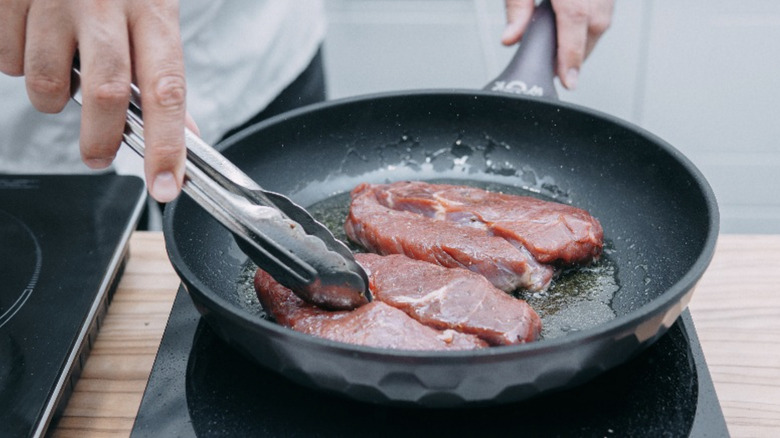
When beef releases a large amount of water in the pan, it’s telling you something about:
- how the animal was raised
- how the muscle developed
- how the meat was handled and processed
Because meat isn’t just protein.
It’s structure.
Muscle Structure, Movement, and Moisture
Animals raised in different systems develop differently.
Cattle that:
- move across pasture
- graze continuously
- engage natural muscle patterns
develop denser muscle fibers and different water-holding characteristics.
Animals raised in more confined or industrial systems often produce meat that:
- holds more free water
- breaks down differently under heat
And you see that immediately—in the pan.
Why This Matters for Cooking
When excess water is released:
- the pan temperature drops
- the Maillard reaction is delayed
- flavor development is reduced
Instead of:
sear → crust → flavor
You get:
steam → grey → diluted taste
That’s not a technique issue. That’s the raw ingredient telling you something.
Where Food as Medicine Actually Begins
We often talk about food as medicine in terms of:
- nutrients
- ingredients
- dietary choices
But what happens in the pan is part of that story.
Because how food behaves during cooking reflects:
- its composition
- its structure
- and the system it came from
Research from institutions like the USDA Natural Resources Conservation Service and the Rodale Institute has increasingly pointed to the connection between:
soil health → plant health → animal health → human health
And that connection doesn’t disappear when you start cooking.
Cleaner Inputs, Different Outcomes
Beef raised in regenerative systems—on diverse pasture, with continuous movement—often shows:
- more stable cooking behavior
- better browning
- less excess moisture loss
But more importantly—
it reflects a system that is:
- building soil
- supporting ecosystem function
- producing food with greater integrity
This is where “clean” actually means something.
Not just:
- no additives
- no processing
But a system that supports the food from the ground up.
The Chef’s Signal
For chefs, this is one of the clearest signals.
You don’t need a lab test.
You don’t need a label. The pan tells you.
If it’s steaming instead of searing—
pay attention.
Closing
Food as medicine doesn’t start with nutrients.
It starts with how that food was raised.
Because the difference isn’t just in how it tastes.
👉 It’s in how it behaves.
👉 It’s in how it was built.
👉 It’s in the system behind it.
